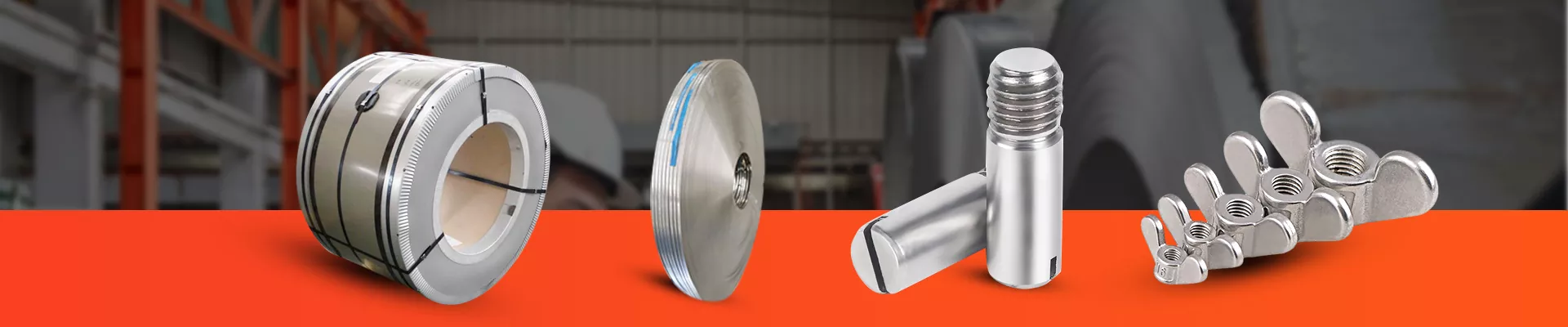
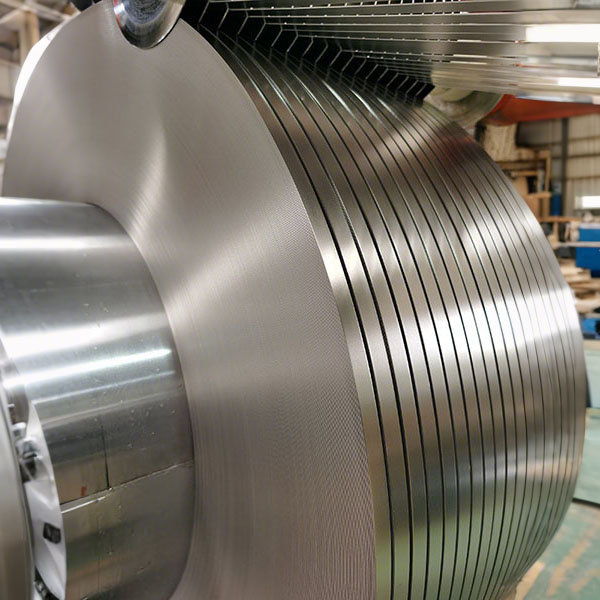
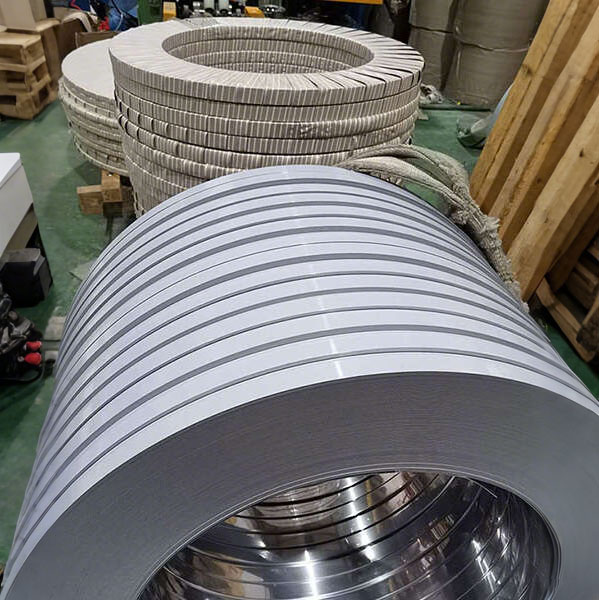
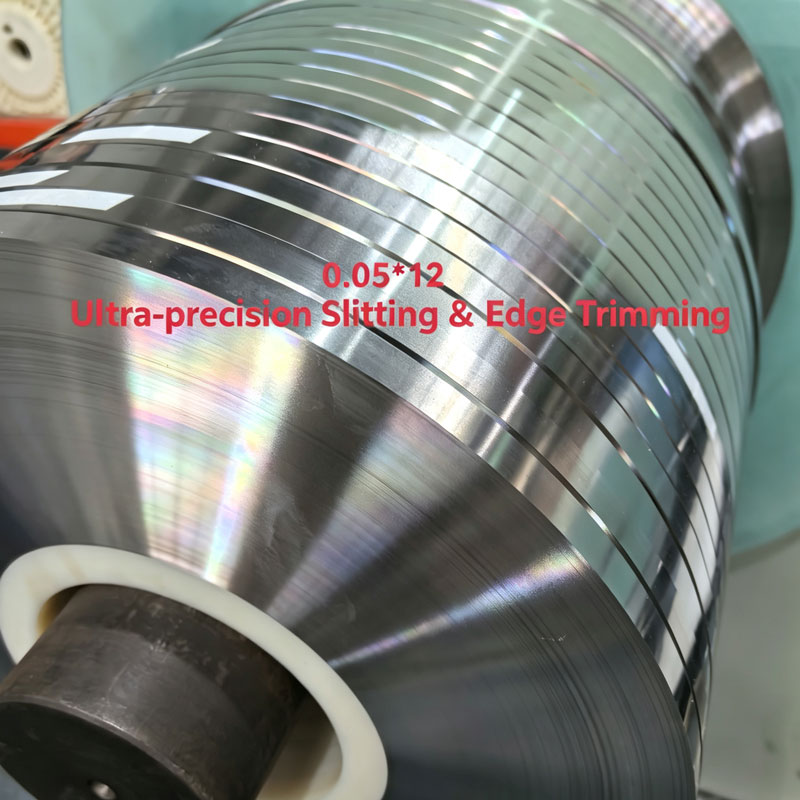
0.05mm stainless steel spring strip from Qihong is rolled to 0.050 mm nominal with a ±0.002 mm band, slit 2 to 300 mm wide in 1/4H to H temper for contacts, shims and flat springs. The Ningbo manufacturer tempers, slits and reports hardness on every coil.
Drawings say 0.05 mm and presses disagree. At this gauge the nominal figure is a band rather than a fact: the tolerance is a few percent of the section, a burr can be a tenth of it, and the coil's own winding leaves a curvature that surfaces as a mis-feed two metres into the run. 0.05mm stainless steel spring strip from Qihong is rolled, tempered and slit in Ningbo, China against a stated micron band instead of a mill convention, so the part is designed around numbers you can measure on arrival.
50 µmnominal section
±2 µmgauge band, agreed per order
119 g/mat 300 mm width
Why 0.05 mm
The spring-temper range on this line starts at 0.05 mm and runs to 3.0 mm, while the foil range runs from 0.01 to 0.30 mm and covers the same gauge from the other direction. So this is the seam: the thinnest section still handled as strip, and the point where the failure modes stop being metallurgical and start being dimensional.
Gauge is a band, not a number. At 0.050 mm a ±0.002 mm window means the section moves by 4% from coil to coil. A press set up on the low side of that band and fed from the high side changes its shut height by more than most progressive tools tolerate.
Grain becomes a fraction of the section. At ASTM grain size 8 the average grain is about 22 µm, close to half the thickness. The part is only two or three grains deep, so scatter between heats is metallurgical rather than a rolling fault, and no amount of gauge control removes it.
The burr competes with the thickness. Five micrometres is invisible on 0.30 mm and is 10% of the section here, which is why edge condition is ordered as a number on this gauge and left to convention on heavier strip.
Coil set is made by winding, not by rolling. Thin section takes a permanent curvature from its own tension on the recoiler, and the coil core diameter decides how much.
Mass is low, length is long. At 300 mm wide the strip weighs about 119 g per metre, so a 100 kg coil runs to roughly 840 m. Good for uninterrupted production, unforgiving if the first ten metres are wrong.
None of this is a defect in the material. It is the physics of a 50 µm section, and it is why 0.05mm stainless steel spring strip has to be specified by gauge band, burr height and coil build together rather than by grade name alone.
Tolerance Maths
A ±0.01 mm tolerance is unremarkable on 0.5 mm strip and impossible here: it would be 20% of the section. Tolerance only means something as a share of nominal, and that share is what sets the price of this gauge.
Nominal gauge
Typical band
Share of section
0.50 mm
±0.010 mm
2.0%
0.20 mm
±0.005 mm
2.5%
0.10 mm
±0.003 mm
3.0%
0.05 mm
±0.002 mm
4.0%
Crown. A mill leaves the centre slightly heavier than the edges. On heavy strip that is a flatness question; here it is a gauge question, because the difference between centre and edge can approach the whole tolerance band.
Edge drop after slitting. Slitting shears rather than cuts, and the last half millimetre at each edge can thin. It matters on 2 to 10 mm widths where the edges are a large share of the face.
Roll eccentricity. Shows up as a periodic wave in thickness along the coil, with a wavelength equal to the work roll circumference. A micrometer reading taken at one point will miss it entirely.
Measurement itself. A hand micrometer with flat anvils compresses thin strip slightly and reads low; a dead-weight or non-contact gauge does not. Ask which instrument the certificate figure came from before comparing two suppliers.
Write the tolerance as a band plus a measurement method, for example "0.050 mm ±0.002 mm, measured mid-width by non-contact gauge". A bare "0.05 mm" on a purchase order will be met by any supplier in any way that suits them, and the argument afterwards is about interpretation, not quality.
Holding 4% on 50 µm is a rolling and tension-control problem rather than an inspection problem, which is why 0.05mm stainless steel spring strip is quoted with the band attached to the gauge and confirmed per coil instead of being promised as a catalogue figure.
Hardness at Gauge
Hardness is normally quoted as one number. At 0.05 mm it is first a metrology decision, because the indent has to fit inside the section before the reading means anything.
Load changes the answer. At HV 550 a 0.1 kgf indent is about 18 µm across and roughly 6 µm deep, an eighth of the section, which ASTM E384 accepts because the thickness exceeds 1.5 times the diagonal. The same material tested at 1 kgf needs a diagonal of 58 µm and therefore 87 µm of section, so the test is invalid here whatever the instrument prints.
Quote the load with the value. HV 550 at HV0.1 and HV 550 at HV1 are different claims about the same coil. A certificate without the load is not comparable with anything.
Tensile runs on the full section. No machined specimen can be made from 50 µm, so the test is a strip tensile on the as-supplied width, and the result depends on specimen width and grip alignment. Ask for the width used.
Check across the width, not only along it. Annealing and temper rolling both leave the edges and the centre slightly apart. Three readings, two edges and the middle, tell you more than a single number in the centre.
Expect a wider scatter than on heavy strip. Two or three grains through the section means the indent can land on a grain boundary or inside one grain, and the spread between readings is real material behaviour rather than operator error.
The practical fix is a purchase order line that names the method: hardness in HV with the load stated, tested at three positions across the width, reported per coil. That turns 0.05mm stainless steel spring strip into a material your incoming inspection can actually reject, which is the only kind of specification worth writing.
The Spec Sheet
The figures below are the working window for this gauge. Anything outside them is quoted individually rather than promised from a table.
Item
Specification
Nominal gauge
0.05 mm (0.050 mm); 0.05 to 3.0 mm available in the same series
Thickness tolerance
±0.002 mm typical at this gauge, band agreed per order
Width
2 to 300 mm slit; narrower or wider by agreement
Grades
201, 301, 304, 316L, 631, 430
Temper
Annealed, 1/4H, 1/2H, 3/4H, H
Hardness report
HV at a stated load (HV0.1 or HV0.2), three positions across the width
Tensile strength
1100 to 2100 MPa across the hard tempers, confirmed per grade and temper
Flatness
0.03 mm/m or better on the finished slit coil
Surface
2B, BA, brushed, polished; oiled or dry as specified
Edge
Slit, round edge, or deburred to a stated burr height
Delivery form
Coil, oscillate-wound spool, cut length
Coil weight
Set to your decoiler capacity; about 840 m per 100 kg at 300 mm
ISO 9001 quality system, SGS; RoHS documentation on request
Minimum order
100 kg standard; 5 to 20 kg trial length for tool qualification
Three lines do most of the work on the enquiry: the gauge band with its measurement method, the burr height you can live with, and the coil weight your decoiler can carry. Everything else can be adjusted after the first coil; those three decide whether the first coil runs at all.
Width is worth a second look before the drawing is frozen. The narrower the slit, the larger the share of the face taken by the sheared edge: on a 2 mm wide part, half the face can be edge-affected, which leaves very little parent metal to carry the load. That is a design decision rather than a purchasing one. Send the finished blank size with the enquiry so 0.05mm stainless steel spring strip is quoted at the width the tool actually needs.
Edge and Burr
A burr is a height, and on thin strip a height is a percentage. Five micrometres on 0.30 mm is 1.7% of the section and disappears in a deburring pass; five micrometres here is 10%, and it becomes the tallest thing on the part.
Slit edge is the default and the cheapest. It carries a rolled-over edge on one side and a burr on the other, and the burr side should be named on the drawing so the tool can put it inside the bend or away from a sliding contact.
Round edge removes the sharp corner by shaving or rolling. It costs a pass, protects operators and dies, and is the usual choice for parts handled in bulk or fed through a guide rail.
Deburred to a stated height is the only version that can be inspected. "Deburred" alone means different things in different shops; "burr under 3 µm measured at 200x" is a criterion.
Edge drop from shearing thins the outer fraction of a millimetre. On a 2 mm wide strip that is a quarter of the face, and it shows up later as a soft zone that will not hold a bend.
Handling marks are the other burr. A scratch across 50 µm is a notch, and a notch on a spring is a fatigue origin. Interleaved winding and gloves at the decoiler matter more on this gauge than on any other in the range.
Edge condition is the cheapest variable to change and the most expensive one to discover late, because a burr problem is normally found by the customer's press rather than by the slitting line. Naming the edge and the burr height on the order is what keeps 0.05mm stainless steel spring strip from being a material that only works on the supplier's own sample.
Coil Build
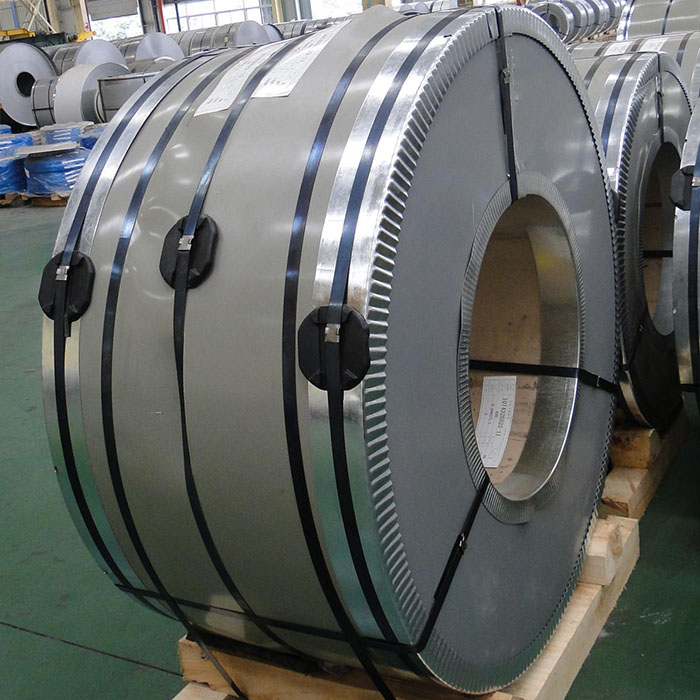
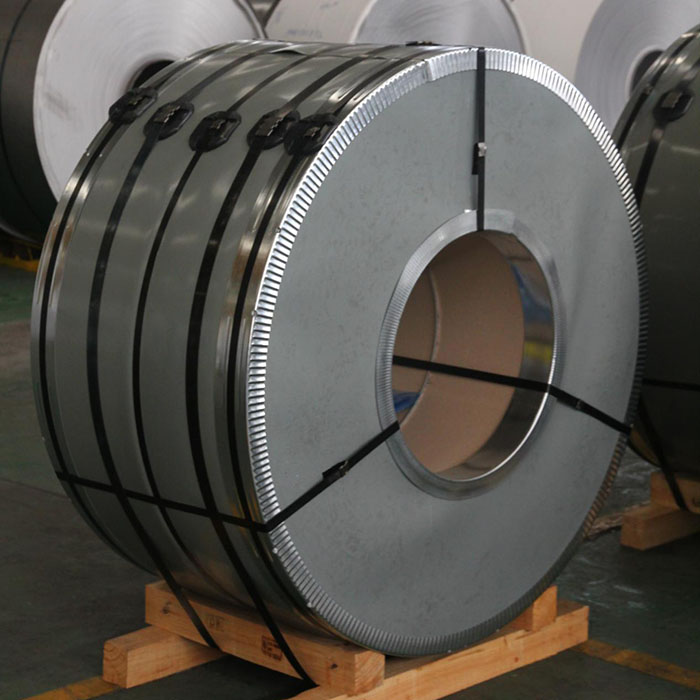
Thin strip remembers how it was wound. Tension on the recoiler, core diameter and the way the laps stack all leave a shape in the coil that the press inherits, and at 50 µm that shape is as influential as the temper.
Coil set is a lengthwise bow that appears when the strip is unwound. It comes from winding tension and from the core diameter, and it is reduced by a larger core and lower tension rather than by levelling afterwards, since levelling on this gauge would cost hardness.
Crossbow is a widthwise curvature, usually inherited from the mill and amplified by slitting. It shows as a part that rocks on a flat plate and as inconsistent blank location in a die.
Telescoping happens when laps slide sideways during winding. Interleaving or edge guidance prevents it; nothing fixes it once it has happened in transit.
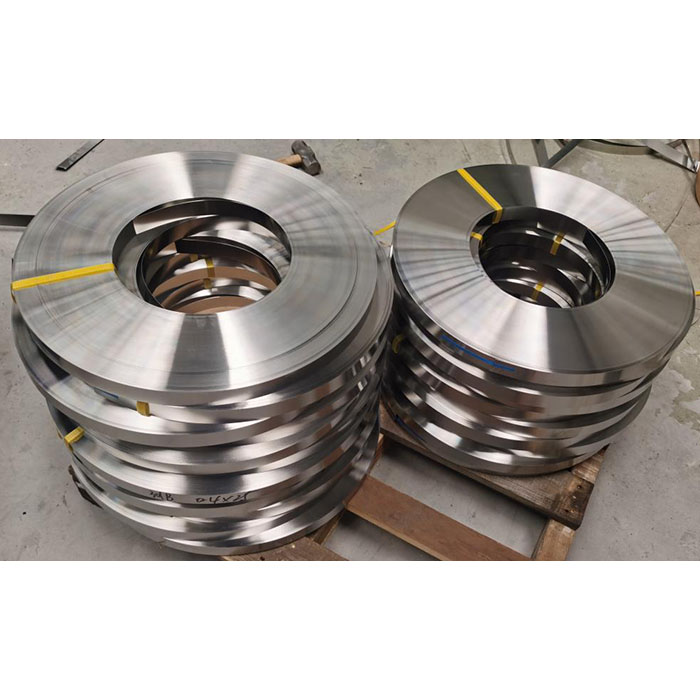
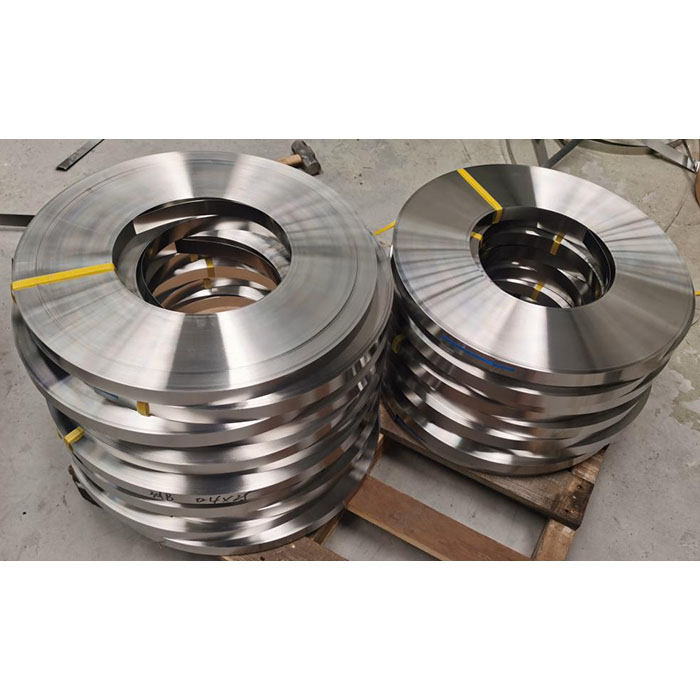
Oscillate winding lays the strip back and forth across a wide spool, which removes coil set almost entirely and lets a long run continue without a coil change. It is the usual delivery form for narrow widths and long lengths.
Coil weight is a handling decision. A 100 kg coil at this gauge is over 800 m of material: fewer coil changes and a longer uninterrupted run, but more weight to lift and more loss if the edge is damaged in transit.
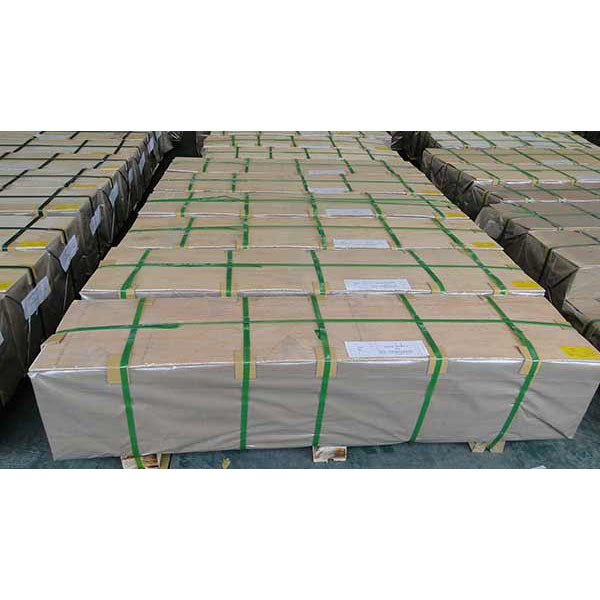
Packing is part of the specification. Moisture-proof paper, interleaving and a fumigated pallet protect an edge that a single strap mark can ruin.
Specifying the coil build is not a detail for the shipping clerk; it is the last process step that decides whether the material arrives flat enough to feed. Rolling, tempering and slitting sit in one plant in Ningbo High-Tech Zone, which is why 0.05mm stainless steel spring strip can be wound to the core diameter and coil weight your decoiler actually runs.
FAQ
QIs 0.05 mm still strip, or already foil?
AIn commercial terms it is both, which is exactly why it causes arguments. Foil is catalogued from about 0.01 to 0.30 mm and strip from 0.05 to 3.0 mm, so a 50 µm section sits inside both catalogues and can be quoted from two different production lines. Those lines do not behave the same way: they run at different tension, slit from different master coil widths and hold different tolerance bands, so the coil that arrives has a different set and a different edge depending on which one made it. None of that is visible on the box. Ask which line will produce your coil and what band that line holds. On this site the spring-temper series starts at 0.05 mm and the ultra-thin series covers 0.01 to 0.1 mm, which is why the same part number can come back with two very different quotes.
QWhat tolerance can you really hold at this gauge?
AAround ±0.002 mm is the normal band, and tighter can be discussed for a specific width and grade rather than promised in general. Two things move the answer. The first is width: a wide coil with a long roll gap is harder to hold than a narrow slit strip, because crown and eccentricity have more room to show. The second is the measurement method, since a hand micrometer and a non-contact gauge will not agree to the micrometre. Tell us the band your assembly needs and the instrument you will check it with, and the quote will be written against that pair rather than against a catalogue number.
QDoes the certificate give tensile strength or hardness?
ABoth can be reported, but they come from different tests and one of them is far more reliable on thin section. Tensile is measured on a full-section strip specimen, so the result depends on specimen width and grip alignment and carries more scatter at 50 µm. Hardness is faster, local and cheaper, but only valid if the load is stated and the section is at least 1.5 times the indent diagonal. For routine acceptance we would put hardness in HV at a stated load on every coil, and tensile on the qualification coil or on request. If your drawing calls for a tensile band, say so at enquiry stage so the test schedule is built into the price instead of added afterwards.
QCan you supply this gauge in full hard?
AYes, and it is the temper most buyers want here, because a 50 µm part is usually a contact, a shim or a flat spring that has to carry load without much travel. The limit is not hardness itself but what the part has to survive afterwards. Full hard material at this gauge has almost no forming reserve, so any bend beyond a shallow radius has to be designed in before hardening, or the part has to be made from a softer temper. Tell us the smallest bend radius on the drawing and the deflection the part sees; that pair, not the hardness number, decides whether H is the right call or whether 1/2H will hold the same load with a workable bend.
QHow long is a coil and how is it wound?
ALength follows from width, because coils are wound to a weight your decoiler can lift. At 300 mm wide the strip weighs roughly 119 g per metre, so a 100 kg coil is about 840 m; at 50 mm wide the same weight is over 5,000 m. Narrow widths are normally supplied oscillate-wound on a spool, which removes coil set and allows a continuous run, while wider material comes as a conventional coil on a core sized to reduce the curvature it takes. Give us the maximum coil weight your uncoiler handles and the length you want between changes, and the winding will be set to match rather than to our standard bobbin.
QWhich edge should I order for a part this thin?
ASlit edge if the part is blanked and the edge disappears into the trim, because it is the lowest-cost option and the burr can be oriented away from the working face. Round edge if the strip is fed through a guide, handled in bulk, or touches a sliding contact, since a rolled edge will not shave the tool or the operator. Deburred to a stated height if the edge remains a functional surface, which is common on contact springs where the burr would sit against a mating part. On 50 µm the burr is a tenth of the section, so it is worth one line on the drawing and one conversation before the coil is slit.
QCan I test a short length before committing to a full order?
AYes, a trial length of roughly 5 to 20 kg is normal for tool qualification against a standard minimum of about 100 kg. The trial is rolled and slit on the same schedule as the production order, which is the only way its behaviour predicts the bulk, and it can be slit to the production width so it runs on the real tool rather than on a laboratory press. Send the blank width, the temper and the edge you intend to use, and the trial will be built to that combination. Results from a trial cut to a different width tell you very little at this gauge, because edge share and camber both change with width.
We use cookies to offer you a better browsing experience, analyze site traffic and personalize content. By using this site, you agree to our use of cookies. Privacy Policy